Song Bank Vault

25 May, 2026 1:13 pm GMT

Introducing the

Song Bank Vault

The easiest way to protect your songs forever

You write songs. Lots of them. Ideas, demos, finished tracks, voice notes, lyric scraps — it all lives in your notebooks, phones, laptops, and emails.


The Song Bank Vault gives you a secure, private place to store your songs, track your creative journey, and prove your ownership — all in one click.

It’s like a digital safety deposit box — but made for songwriters.

And it’s included, unlimited, and automatic with your membership.

If you’re like most songwriters, you’ve asked yourself these questions:

  • “What if someone steals my song?”
  • “Should I mail it to myself?”
  • “Do I need to register it with a copyright office?”
  • “What if someone else tries to claim they wrote it?”

You’re not alone. Every songwriter thinks about this — because your songs matter.

That’s why we created the Song Bank Vault:

A simple, secure way to protect your songs and prove you wrote them — included free with your membership.

Here’s how it works:

  1. Upload your song Demo, voice memo, lyric sheet, finished track — any format is fine.
  2. We lock it in the Vault We time-stamp it and store it securely.
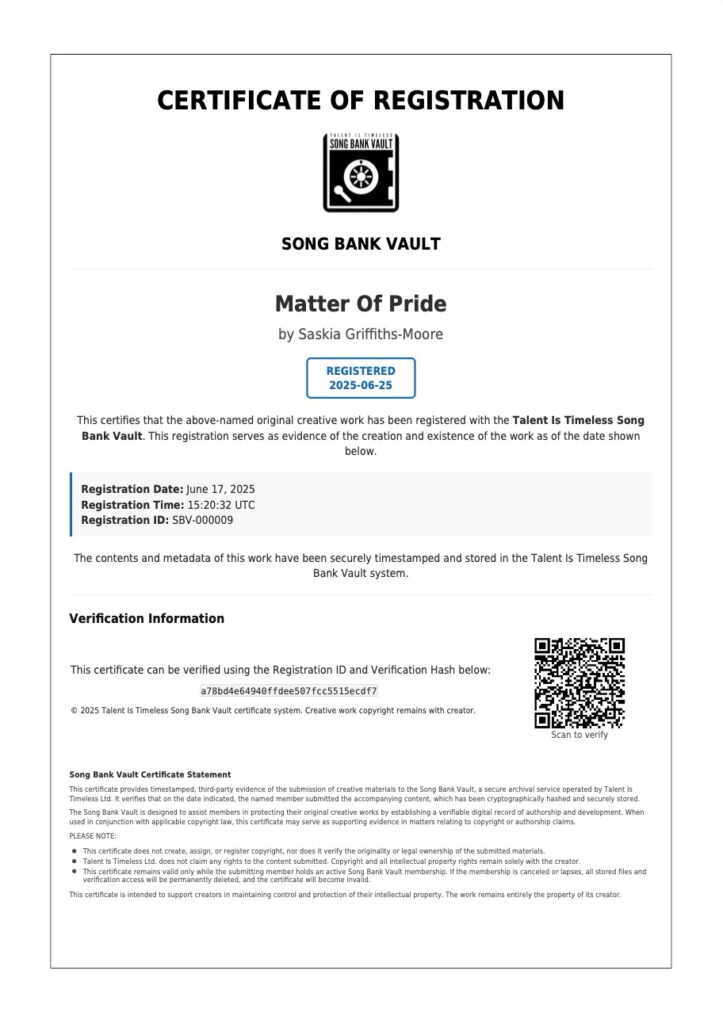
  3. You get a PDF certificate + QR code Your song now has real proof of authorship — ready for labels, publishers, or anyone else who asks.
  4. You get notified when someone scans your certificate If a third party verifies your song (for example: a publisher or music supervisor), we alert you immediately.
  5. You can add lyrics, voice memos, co-writer splits & more Build a full song history, so you can prove how the song developed — not just the final version.

Why this is more than storage — it’s protection.

Every time you save a song to the Vault, you’re creating a legal record of what you made and when. You might not be thinking about copyright law right now — and that’s okay. You shouldn’t have to. We built this for real-world creators:
  • The ones writing every week
  • The ones collaborating with others
  • The ones pitching songs and making moves
  • The ones who don’t have time to deal with government forms or legal guesswork

You already own your copyright.

We just help you prove it. Here’s what most people don’t realize:
  • You automatically own the copyright to your song the moment you create it.
  • You don’t have to register it. You don’t have to mail it to yourself – courts don’t recognize it. It proves nothing.
  • You just need a way to prove you wrote it first — and that’s what this does.
The Song Bank Vault creates a digital trail that actually holds up — and makes you look professional while you’re at it.

Don’t let fear stop you from writing or sharing your music.

The truth is:
  • You already own the copyright to everything you create.
  • You don’t need to spend thousands registering every song.
  • You don’t need a lawyer to feel protected.
  • You just need proof that you wrote it — and that’s what the Vault gives you.
Included in your membership. Unlimited uploads. Lifetime protection. Whether you’ve written 3 songs or 300, the Vault is here to keep them safe.

We want you to feel confident using the Song Bank Vault — and part of that confidence comes from understanding exactly what this tool does, and doesn’t do. Here’s the legal side of things, explained in plain English.

Copyright 101

  • You own the copyright to your song the moment you create it — whether that’s recording a voice memo, writing lyrics in a notebook, or making a demo in your DAW.
  • You do not need to register your song with the U.S. Copyright Office to have legal copyright protection.

Song Bank Vault – Legal Info & Fine Print

  • This protects your songs immediately, for free, and is legally useful in most real-world scenarios.
  • You only need to register with the U.S. Copyright Office if you plan to sue for copyright infringement in federal court which typically costs $25,000–$100,000+ just to get started.

How Copyright Actually Works

  • You automatically own the copyright to your original song the moment you write it down, record it, or save it.
  • Registration is not required to own a copyright.
  • Registration is required only if you want to file a federal lawsuit — and those typically cost **$25,000–$100,000+**just to get started.

And even in court, you can still recover up to $30,000 in actual damages without having registered, as long as you can prove when you created the work.

That’s exactly what the Song Bank Vault helps you do.

What the Song Bank Vault is:

  • A trusted third-party service that creates timestamped, verifiable evidence of your authorship
  • A system that stores multiple versions of your work, showing the song’s evolution over time
  • A way to show publishers, collaborators, producers, or platforms that you have ownership and proof
  • A feature built by and for songwriters — to help you feel safe sharing your work and moving forward with confidence

What it’s not:

  • It is not a substitute for U.S. Copyright Office registration in the rare case of federal litigation
  • It does not guarantee legal outcomes or provide legal advice
  • It does not act as a replacement for consulting a lawyer when major disputes or commercial contracts are involved

Why is this better than the U.S. Copyright Office?

Concern US Copyright Office Song Bank Vault
Proves you wrote it
Costs per song $45 min every time Free & unlimited
Certificate you can show anyone
Needed to own your copyright? ❌ (You already own it)
Needed to sue someone in federal court?
Real-world usefulness for everyday songwriters ❌ Bureaucratic ✅ Made for creators
Easy to do in 60 seconds?

Song Bank Vault FAQ

What is the Song Bank Vault?
The Song Bank Vault is a secure, timestamped digital archive for your songs. It lets you upload lyrics, demos, voice memos, co-writer splits, and more — and gives you a legally useful certificate proving when you submitted the work. It's built to help you protect your authorship, track your creative process, and feel confident sharing your music.
Do I need to upload the finished version of my song?
Nope! You can upload a rough demo, voice memo, lyric draft, or even a chord chart. The Vault is designed to protect your process, not just your polished songs. You can come back and upload new versions as your song evolves.
I only have lyrics — is that enough?
No, not at the moment. Although lyrics alone can be copyrighted as a "literary work" or part of a musical composition, we aren't currently catering for lyrics only Vault entries.
I just wrote the music — no lyrics. Can I still protect it?
Absolutely. Instrumentals, melodies, chord progressions (if original), and musical arrangements can all be protected. Upload your recordings, sheet music, or notation files — and you'll have clear evidence of authorship.
I co-wrote a song with someone — can we both be listed?
Yes! When uploading, you can enter co-writer names and assign ownership percentages. This keeps your rights clear and avoids disputes down the line.
I only wrote part of the song — does that count?
Yes. Copyright law protects any original contribution. Whether you wrote a single verse, a guitar hook, or the chord progression, you still have rights in the final work if you were part of its creation.
Can I copyright a chord progression?
Sometimes. Basic, common progressions like C–G–Am–F aren't protected because they're considered musical building blocks. But original, distinctive progressions in context can contribute to a protectable musical composition.
Can I protect an instrumental solo or riff?
Yes — as long as it's original and not copied from another source. A distinctive riff, melody, or instrumental line can be protected as part of a musical composition.
Can I upload a MIDI file or sheet music instead of audio?
No, an audio file is a basic requirement for all Vault entries! Note that currently our Vault accepts WAV, MP3 and FLAC file types for audio, and PDF files for sheet music—but to PDF files must accompany an audio file, and cannot be used alone, instead of an audio file.
Should I still mail the song to myself as proof?
No. That's an outdated method that doesn't hold up well in legal situations. It's unreliable, easily faked, and not officially recognized in court. The Vault is a much stronger and more modern alternative.
Do I still need to register with the U.S. Copyright Office?
Only if you plan to file a copyright infringement lawsuit in federal court. For everyday protection — proving you wrote your song, establishing a timeline, sharing with publishers, or resolving disputes — the Vault is more than enough.
What does it cost to use the Vault?
It's included in your membership — no extra fees, no limits, no surprises. Upload as many songs as you want, whenever you want.
What does the certificate do?
Every upload comes with a downloadable certificate showing:

• The date and time you submitted your song
• A cryptographic hash of the files (your digital fingerprint)
• A scannable QR code for third-party verification

This certificate can be used to prove authorship in disputes, share with collaborators, or demonstrate professionalism to industry reps.
What happens when someone scans my certificate's QR code?
They'll be taken to a secure verification page showing the timestamped record of your submission. You'll also be notified when someone views it — with location and time info.
Can I update a song or add new versions later?
Yes — and we encourage it! You can upload alternate versions, rough drafts, remixes, lyric changes, and more. The Vault keeps a record of your song's development.
How is my work protected technically?
Each upload is:

• Timestamped and stored on secure cloud servers
• Linked to your account for easy access and verification

No one can alter or fake the submission once it's uploaded. You hold the keys.
Who can see my songs?
Only you — unless you choose to share the certificate or invite collaborators. Your songs are private by default.
Can the Vault be used in legal disputes?
Yes — as strong supporting evidence. While it's not a legal registration, it's a trusted third-party record that proves you created your work on a certain date, which is crucial in disputes, licensing questions, or takedown requests.
Is this valid outside the U.S.?
Yes — copyright law is largely harmonized worldwide through treaties like the Berne Convention, which most countries follow. Your timestamped evidence can be valuable in most international contexts, especially if combined with other documentation.
Should I still talk to a lawyer if there's a big problem?
Yes. While the Vault gives you excellent protection and clarity, if you're dealing with a major dispute, contract breach, or litigation, a qualified entertainment or IP lawyer can give you tailored advice.
What happens if I cancel my membership?
The Song Bank Vault is available exclusively to active, paid members of the community with membership levels including: Circle, Standard, Premium, Pro and Founders. Free members and those with inactive accounts do not have access to this service.

The Vault is a living, active service — not just a one-time download. To keep your songs protected, verified, and accessible, you'll need to maintain an active membership.

If you cancel your membership:

• Your stored songs and files will be permanently deleted
• Your certificates and QR code verification pages will become inactive and unverifiable
• You will no longer be able to use the Song Bank Vault as proof of authorship

We do this to ensure integrity, privacy, and ongoing trust in the system. If you value long-term protection, make the Vault part of your songwriting routine.
"Do I give up any rights to my song by uploading it to the Vault?"

Absolutely not. When you upload your work to the Song Bank Vault, you retain 100% ownership and full copyright.

We do not claim, license, distribute, or share your work.

Your songs are stored securely, and only you (or those you choose to share with) can access them. Uploading to the Vault helps protect your rights — it does not transfer them.

Song Bank Vault - Live Demo

Tell us where you're based!

We’re rolling out something exciting — but first, we need to know where you’re based. It only takes a second, and you’ll only ever need to do it once!

You can choose who sees your information —
set it to ‘Only Me’ or make it public.
It’s up to you!